 Email article
 In 2010 Facebook launched its own e-mail service, giving all Facebook users their very own @facebook.com e-mail address which can be used to communicate with the outside world. When it was launched Facebook e-mail was called a ‘Gmail killer’. Fast-forward to 2012 and we now know the only thing Facebook e-mail has killed is time. Still, however, Facebook seems determined to make users use Facebook e-mail. In a move that is likely to receive a lot of criticism, over the weekend Facebook has changed all Facebook users’ listed e-mail addresses to ‘@facebook.com’.
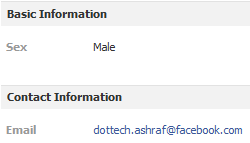
Over the weekend Facebook silently changed everyone’s listed e-mail address to their @facebook.com one. When I say “listed e-mail address” I mean the e-mail address(es) attached to your Facebook profile — the one(s) you see under the ‘Contact Information’ of your profile. According to reports, if you already had your @facebook.com e-mail address listed then any other e-mail addresses you had listed were hidden; if you didn’t have your @facebook.com e-mail listed, then your @facebook.com e-mail was added and other e-mail addresses hidden.
As per my experience (I didn’t have my @facebook.com e-mail address listed), the @facebook.com e-mail address is added with ‘Friends Only’ and ‘Show on Profile’ privacy settings; you are given the ability to change the settings, if you desire.
Unfortunately there is no way to remove the @facebook.com e-mail address from your profile. You can, however, select to display the e-mail address to ‘Only Me’ and select to make it ‘Hidden From Profile’ if you don’t want anything to do with the address. You can also modify the settings for your other e-mail addresses to re-show them if desired. Simply head over the Edit Profile -> Contact Information section of Facebook to make these changes.
For those that don’t know, any e-mails sent to your @facebook.com address are received in your Facebok Messages inbox; and you have the ability to reply to any e-mail address from the same place — all outgoing messages are sent using your @facebook.com address.
In of itself the concept behind @facebook.com isn’t necessarily a bad thing; it has its pros (e.g. protecting users’ private e-mail addresses) and cons (e.g. forcing users to manage another e-mail address). This article isn’t judging Facebook e-mail; we aren’t saying it is good or bad. The issue at hand is how Facebook stealthily made this change to users’ profiles.
What Facebook should have done is made an announcement of this change and, ideally, prompt users with a notification the next time they login allowing users to pick what they want to do. Instead what Facebook did was abuse the trust people have given it by forcing an intimate change on its users.
In its defense Facebook says it made an announcement back in April mentioning users would get updated URLs and e-mail addresses; and that Facebook will roll out “a new setting that gives people the choice to decide which addresses they want to show on their timelines”, presumably hinting at this @facebook.com change that just happened over the weekend.
I’m not a major Facebook user. The only reason I have a Facebook account is for dotTech’s fan page. If I was a Facebook regular, I was be extremely upset at this new development. How about you? Lash out (or defend Facebook) in the comments below.
[via LA Times]