How to disable Java for Firefox, Chrome, Internet Explorer, or Opera [Guide]
August 31, 2012 14
Email article | Print article
If you are fed up with Java’s security vulnerabilities but are not willing to completely uninstall Java from your computer, a potential middle ground is disabling Java in your browser. This guide shows you how to disable Java in Firefox, Google Chrome, Internet Explorer, and Opera.
Table of Contents
- How to uninstall Java for Firefox
- How to uninstall Java for Chrome
- How to uninstall Java for Internet Explorer
- How to uninstall Java for Opera
- Conclusion
How to Remove Java From Firefox
To uninstall Java for Firefox, do the following:
- Run Firefox, open Add-ons Manager, and go to Plugins:
- Next find Java in the list of plugins. There should be two Java plugins, one is “Java Deployment Toolkit” and the other is “Java(TM) Platform SE”. Click the “Disable” button for both of these two Java plugins:
You know you have done it right when it says “(disabled)” by the name of both plugins:
- Done!
You can close Add-ons Manager when you are finished. You do not have to restart Firefox for the changes to take affect.
How to Remove Java From Chrome
To uninstall Java for Google Chrome, do the following:
- Run Chrome, type “chrome://chrome/settings/content“ (without the quotes) in the URL/address bar, and hit Enter on your keyboard:
- Now some settings will pop open. Scroll down the list to where it says “Plug-ins” and click on “Disable individual plug-ins…”:
- When you click “Disable individual plug-ins…”, a list will open that shows all the plug-ins Chrome has installed. Scroll down the list to find “Java” and click “Disable” for it:
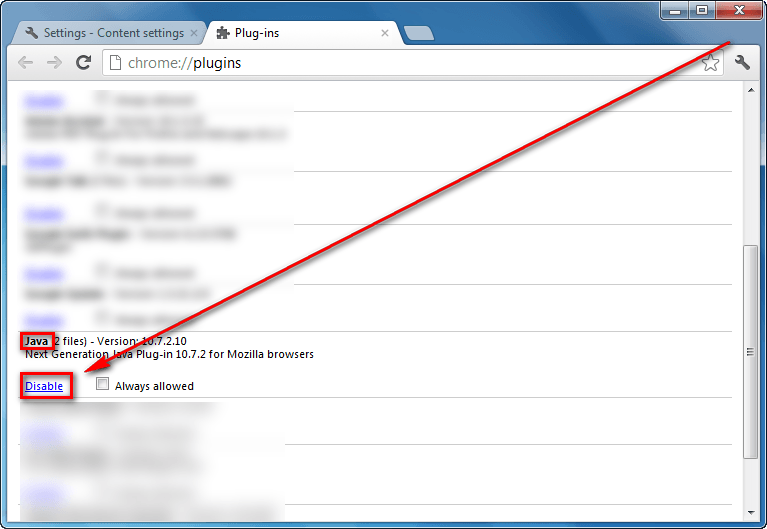
You know you have been successful at disabling Java in Chrome when “Java” is grayed out and it has “(Disabled)” by its name:
- Done!
You can close the Plug-ins and Settings windows when you are finished. You do not have to restart Chrome for the changes to take affect.
How to Remove Java From Internet Explorer
To uninstall Java for Internet Explorer, do the following:
- Run Internet Explorer and open “Manage Add-ons”:
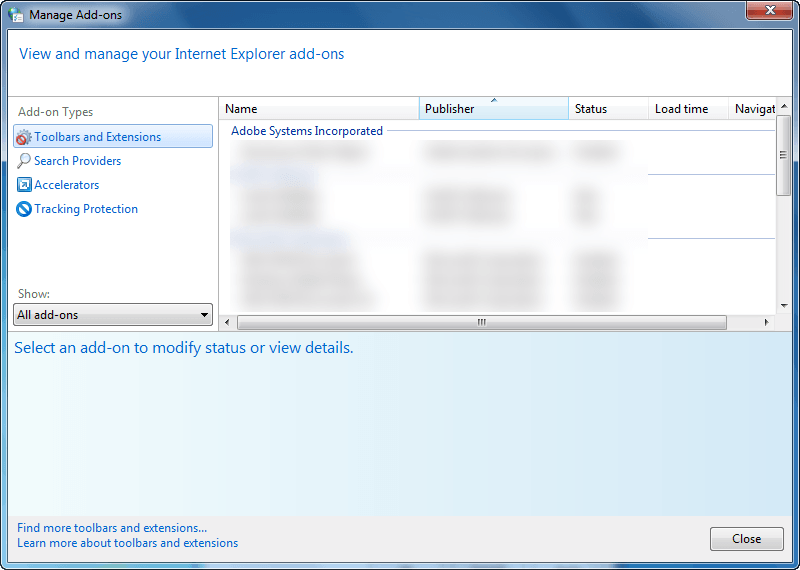
For Internet Explorer 7 and Internet Explorer 8 users, Manage Add-ons is found under “Tools”. For Internet Explorer 9 and 10 users, Manage Add-ons is in the menu that appears when you click on gear icon.
- Once Manage Add-ons is open, change “Show” to “All add-ons”:
- Next scroll down the add-ons list to find “Java(tm) Plug-in 2 SSV Helper” and “Java(tm) Plug-in SSV Helper”. Shift + click on both of these so that they are both highlighted and click “Disable all”:
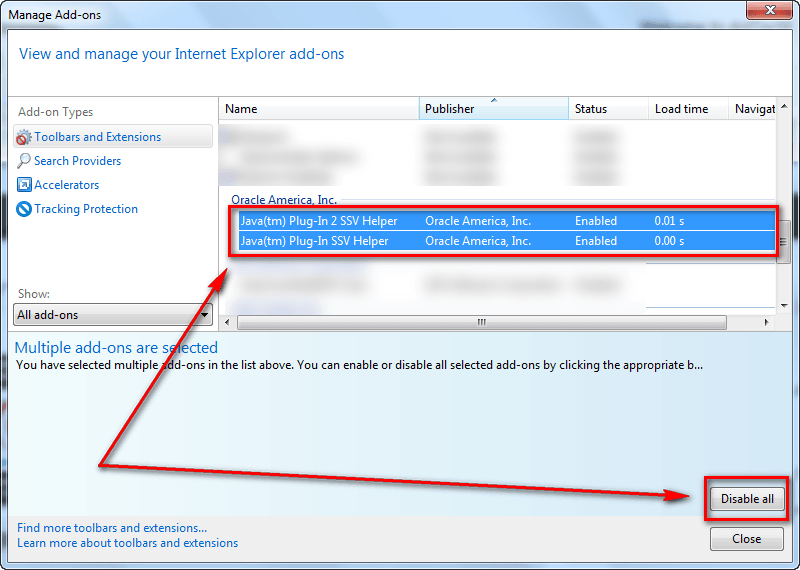
You know you have been successful when the “Status” for both says “Disabled”:
- Done!
You can close the Manage Add-ons windows when you are finished. You do not have to restart Internet Explorer for the changes to take affect.
How to Remove Java From Opera
To uninstall Java for Opera, do the following:
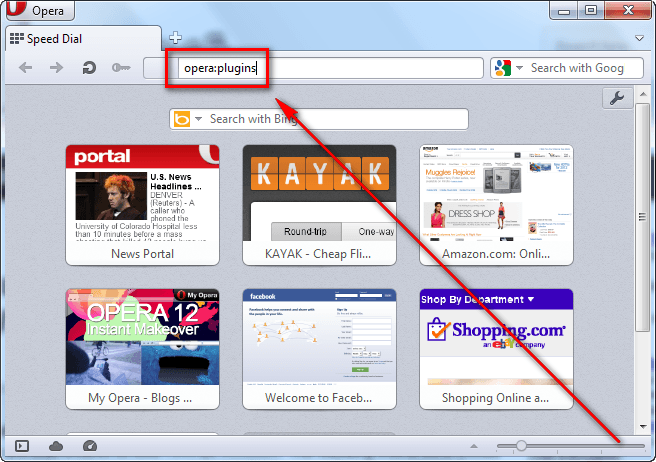
- Run Opera, type “opera:plugins” (without the quotes) in the address bar, and hit Enter on your keyboard:
- Now you should see Opear’s Plug-ins list:
Scroll down the list until you find “Java Deployment Toolkit” and “Java(TM) Platform SE”, and click “Disable” for both:
You know you are successful when both plug-ins are grayed out and “Disable” changes to “Enable”:
- Done!
You can close the plug-ins windows when you are finished. You do not have to restart Opera for the changes to take affect.
Conclusion
You use programs on your computer that require Java, so you are unable to completely uninstall it. While it won’t keep you as safe as completely uninstalling Java, disabling Java in your browser is the second best thing. Enjoy!
14 Comments »
Leave A Response »


![How to read or view non-English text or font on Android, iOS, BlackBerry, Windows Phone, and Symbian [Guide]](http://cdn.dottech.org/media/2013/05/opera-134x90.jpg)
![How to bring back the classic drop-down menu in Office 2007, 2010, and 2013 on Windows [Tip]](http://cdn.dottech.org/media/2013/05/ubit-134x90.jpg)
![More Firefox love [Wallpaper]](http://cdn.dottech.org/media/2013/05/firefox_wallpaper_2560_1440-134x90.jpg)
![How to crack, open, or unlock password protected or encrypted ZIP, PDF, RAR, XLS, and XLSX files on Windows for free [Guide]](http://cdn.dottech.org/media/2013/05/2013-05-04_225743-134x90.png)
Thanks Ashraf,
One of mine was already disabled, with a note saying that is known to cause issues.
For those not very computer experienced, you might mention that Java and JavaScript are two different critters.
And what they should do immediately (in FF) is install the extension ‘NoScript’.
That will disable JavaScript on all new sites that you go to. If a web page complains that it needs JavaScript, one can (if you trust them), click an option to permanently or temporarily allow JavaScript (for that site)
@Rob (Down Under):
> you might mention that Java and JavaScript are two different critters.
Very interesting point.
If we disable Java like the article explains, will JavaScript be automatically disabled too?
@GF:
No they are two different programming languages.
So after disabling Java, the JavaScript will continue to run.
Disabling one or the other, has no effect on the other.
@Rob (Down Under):
OK.
But at this point another question arises: is Java the only dangerous one? As far as I know the Java scripts (by JavaScript) are the most ill-famed…
In your browser I would say JavaScript is the most dangerous. Mainly because there would be more attempts to get at you (via your browser) using JavaScript.
Trust me, if you are using Firefox, you must ‘install’ NoScript.
It is the greatest thing since sliced bread.
Rob
PS To illustrate how important I think it is.
If FF brought out a new release, with extra goodies.
And if I heard that that new release could not use NoScript, then wild horses would not make me upgrade to the new FF.
My example is mythical, because one generally does not get a ‘heads up’ pre-advising that an extension will not work. And it has never been a problem in the past, as NoScript appears to keep up to date, well.
There is a handy-dandy add-on for FF called QuickJava. QuickJava adds a row of buttons to the add-on bar, one each for JavaScript, Java, Flash, Silverlight, Cookies, Images, Animated Images, CSS, and Proxy. When a button is clicked on, it toggles the enable/disable status for that item.
I use it often for Flash, and CSS (to get rid of annoying website ‘features’), and always have Silverlight toggled off. It really speeds up loading certain websites.
Perhaps I will be using it for Java more often.
@Rob (Down Under): 100% agreement about NoScript!
I am JavaScript programmer and I can affirm to you that JavaScript can do nothing outside your browser, unlike Java.
What about Android phones and the different browsers? Are the Java problems the same? I am using Opera Mobile, Chrome and Maxthon.
Hello there! I know this is kinda off topic nevertheless I’d figured I’d ask.
Would you be interested in trading links or maybe guest authoring a blog
article or vice-versa? My blog addresses a lot of the same topics as
yours and I believe we could greatly benefit from each other.
If you’re interested feel free to shoot me an email. I look forward to hearing from you! Wonderful blog by the way!
Well done article! Thank you Ashraf.
if you disable java, a lot of the internet doesn’t seem to open, like I just tried to look for more extensions, the Web Store wouldn’t open. I enabled java script and it opened. It seems that java is necessary, what do you replace it with that will do what java does?
@LL:
You should try to be clearer with your posts, especially since some of the posts above are attempting to clarify that Java and Javascript are two different things.
When you talk about the web store, do you mean the Tools Menu / Add-ons / Extensions ?
Your post mentions both Java and Javascript. Which have you disabled ?
I have Java disabled in Plugins, and I can still open the Extensions from the Tools menu.
When you said – “if you disable java, a lot of the internet doesn’t seem to open”
Do you mean “if you disable JAVASCRIPT, a lot of the internet doesn’t seem to open”
If that is what you meant to say, then enable Javascript, and install the NoScript extension.
From that day on, any new web page you visit will have Javascript disabled. You can permanently enable it for that web site (or temporarily enable it) if you trust them.
[@Rob (Down Under)]
Thank you both, Ashraf and Rob for this info. I am still trying to learn and it certainly is an ongoing process with computers. Java has had my mind muddled for quite a time now (although muddling my mind does not take much at my age). I will add NoScript to FF and see if all goes well.